Chlamydia test at a location near you
PCR test for a frequently reported bacterial STD.
- Sample
- Urine (penis) or vaginal swab
- Reliable after
- 2 weeks
- Result within
- 36 hours
Add to your order
No referral needed
Added to your order
Click the button to view your cart
Included Markers
1 markersChlamydia (PCR)
A chlamydia test shows whether the bacterium Chlamydia trachomatis is present in your body. We use a PCR test. That method looks for the genetic material of the bacterium itself. That makes it sensitive enough to find an infection you cannot feel.
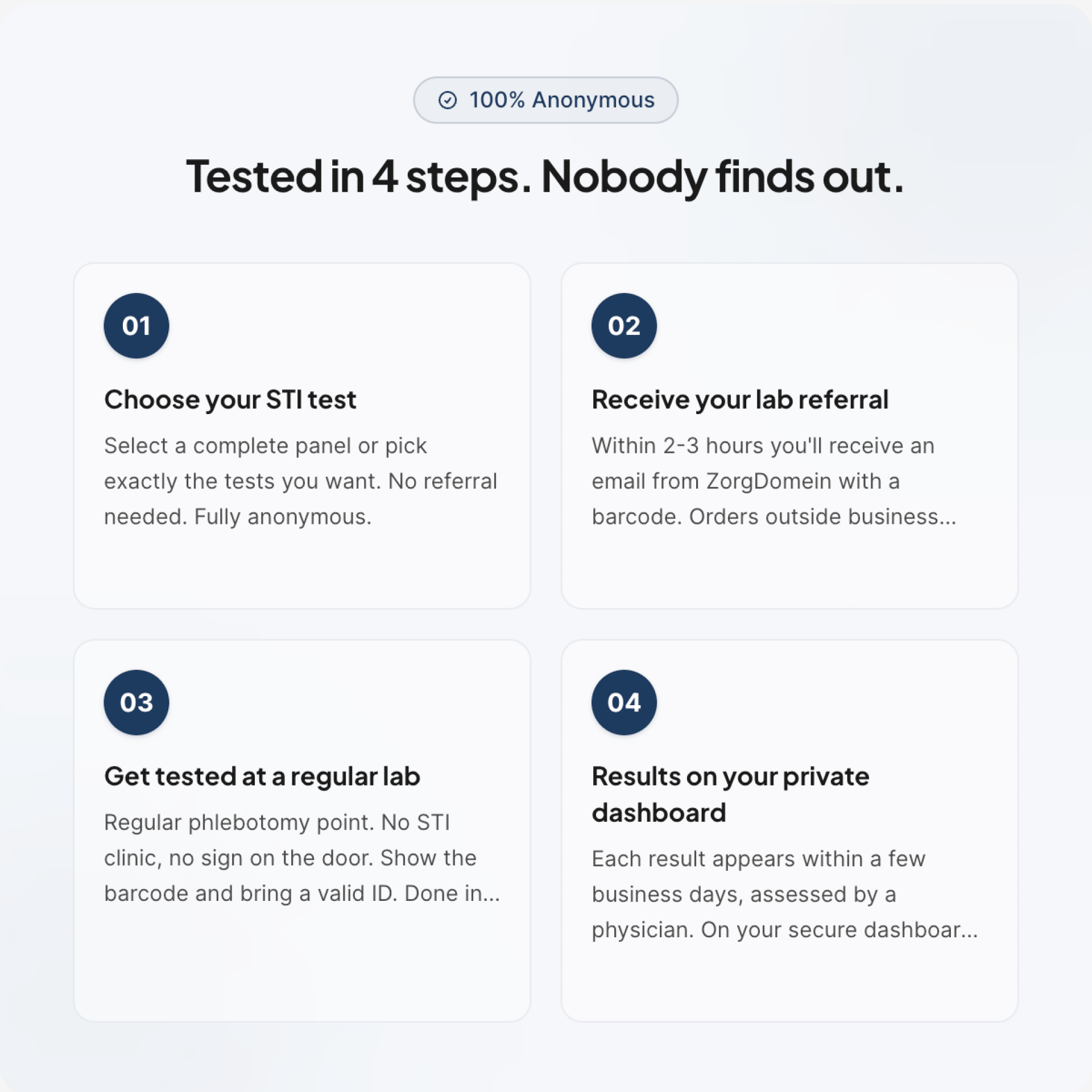
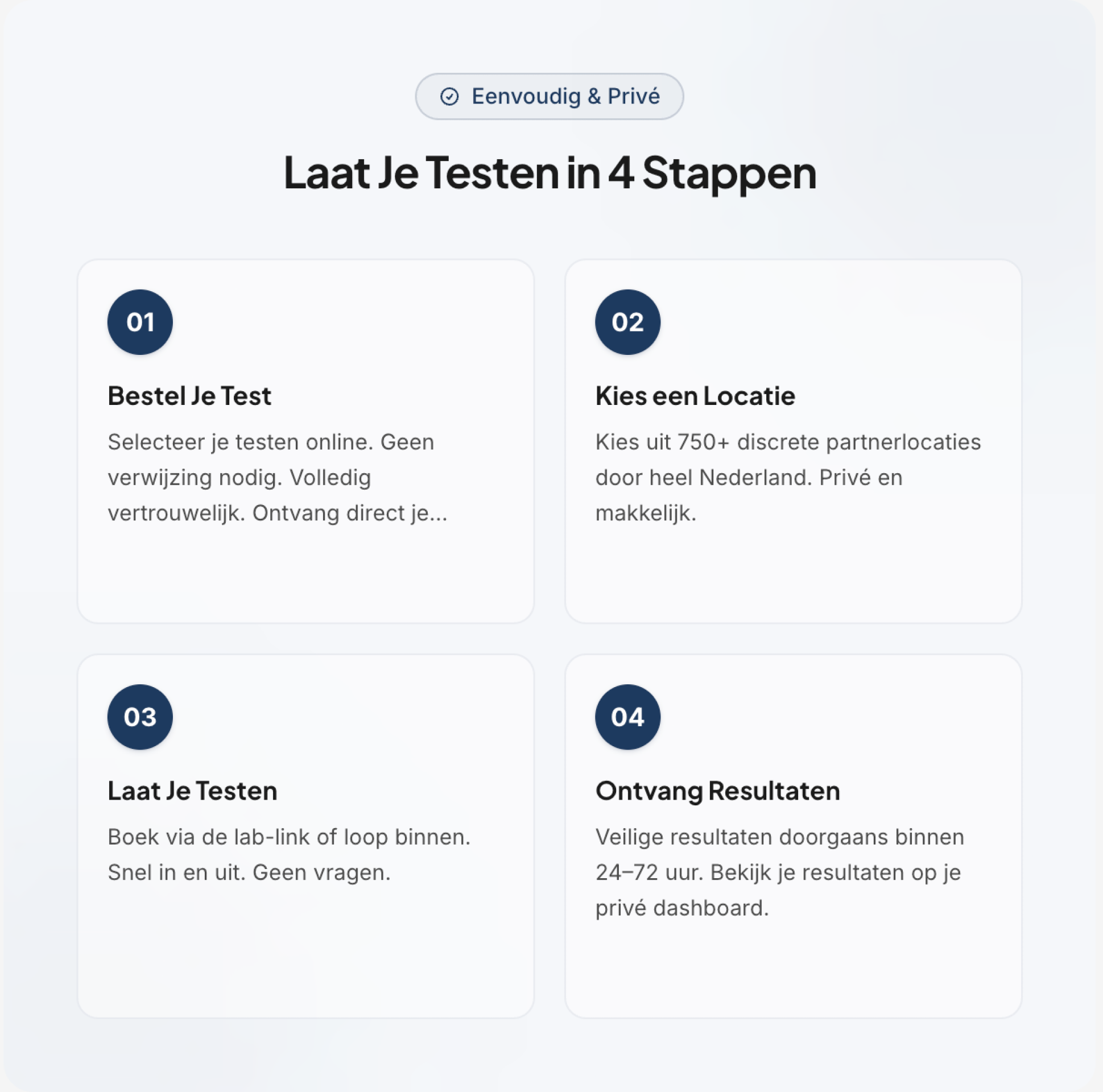
You do not need to see your GP first. You order the chlamydia test online. You hand in your sample at a location near you. Your result appears in your own account.
Why this test?
Because you usually cannot feel it. In women, up to 90 percent of infections cause no symptoms at all. In men it is about half. You can carry the bacterium for months without noticing anything.
If symptoms do appear, they are often pain when you urinate. More discharge than you are used to also fits, or pain low in your belly. Those symptoms fit more than one STI. On their own they do not tell you which one you have.
No symptoms is therefore no proof that you have nothing. A chlamydia test is the only way to know for sure.
Who is this test for?
A chlamydia test can make sense if:
- you have had unprotected sex
- you have a new partner
- your partner has been told they have chlamydia
- you have symptoms that could fit an STI
- you simply want certainty before you go on
Chlamydia is most common in young people. Age rules nothing out, so let the risk you took guide you rather than your age.
What is tested?
This test looks at one thing:
- Chlamydia trachomatis, by PCR
PCR looks for the genetic material of the bacterium. That is different from an antibody test. Antibodies show that you have met the bacterium at some point. PCR shows whether it is there now.
If you want to know exactly what is measured, see the biomarker Chlamydia PCR.
What can this test tell you?
The chlamydia test looks at one site and one moment. If the bacterium is there, the test finds it. That is a clear answer, but also a limited one.
A test at one site says nothing about another. Were you at risk through the throat or the anus? Then a test at that site is needed. And the result holds for the moment of collection, not for the weeks after it.
The test also says nothing about other STIs. Those can be present at the same time, with the same symptoms.
How is the sample collected?
Which sample you hand in depends on where you were at risk.
- Urine fits sex through the penis. You catch the first part of your urine.
- A swab fits sex through the vagina. You collect the material yourself with a cotton swab.
- Throat or anus are separate sites, with their own swab.
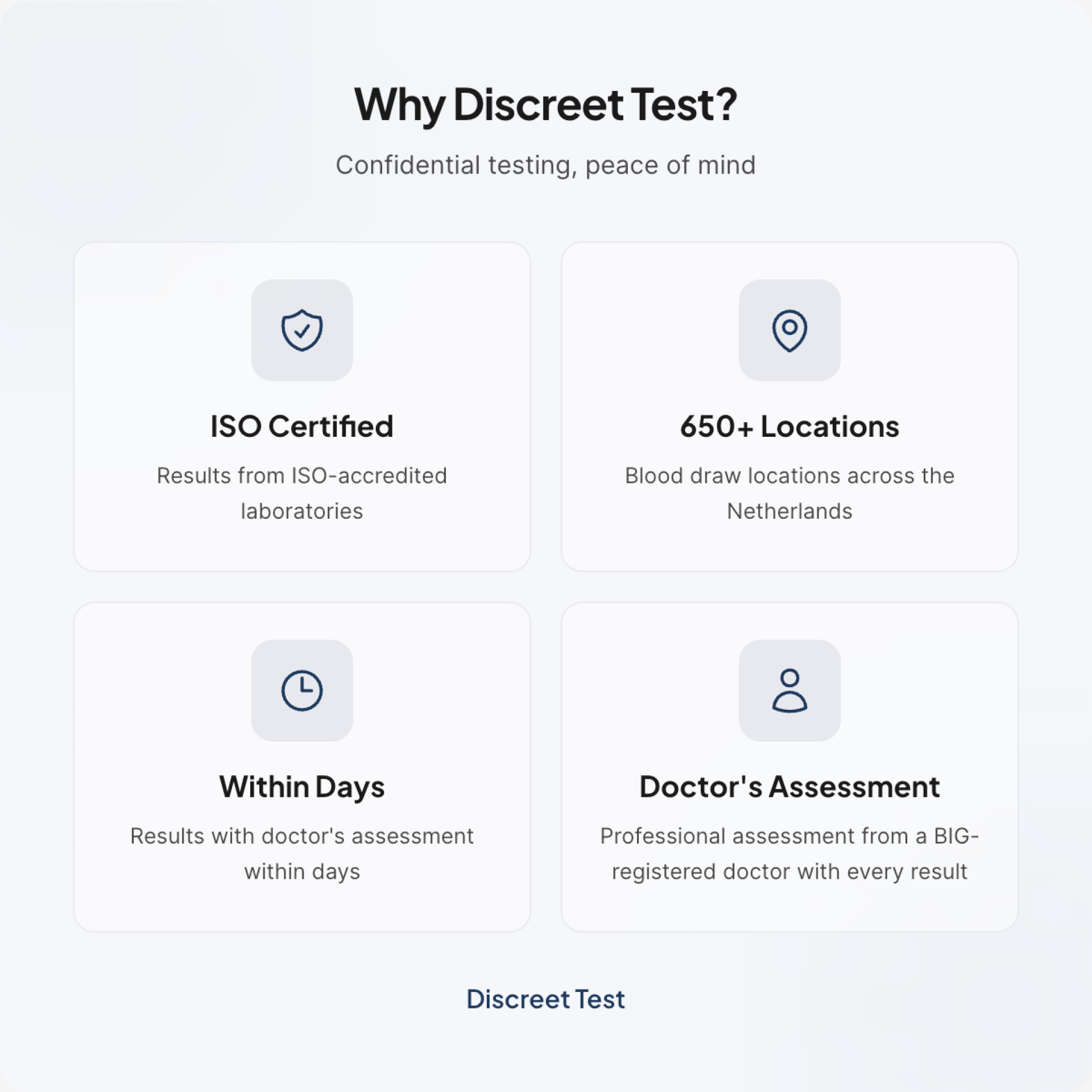
We do not send you a parcel to post back yourself. You hand in your sample at one of the 650+ locations in the Netherlands. These are run by our partner labs: a network of independent, certified laboratories. We do not own these locations.
That saves a step. Your sample goes straight into the lab instead of spending days in the post.
When is this test useful?
Testing too early is the most common mistake. Just after sex there is still too little material in your body to find. The result you get is then of no use to you.
The Dutch RIVM guideline is clear. A PCR test gives a reliable result two weeks after transmission. So wait two weeks after the sex you are worried about. Take the chlamydia test after that.
If you have symptoms, those usually appear after one to three weeks. Two weeks after sex stays a good moment to test in that case too.
What do the results mean?
A PCR result has two outcomes.
Not found. There was no genetic material of the bacterium in your sample at that moment. If you tested on time, so two weeks after sex, that is a reliable answer.
Found. Then you have chlamydia at that moment. It responds well to antibiotics, usually in a short course. Your doctor discusses the next step with you. That often includes letting your partner know they can get tested too.
Preparation
Handing in urine? Then do not urinate for at least 1 hour before collection. That way there is enough material in your sample.
Bring valid ID. You need to identify yourself at the lab with your name and your date of birth. That is part of it, because your result has to be linked to you. Fully anonymous testing is therefore something we cannot offer.
Nothing else is needed. You do not have to fast.
What happens after the results?
How soon your result is ready depends on the sample. We plan for roughly two to five working days. That time starts when your sample reaches the lab. A urine sample usually takes a little longer than a swab. Treat this as our planning figure, not as a hard promise.
Every result is reviewed by a doctor registered in the Dutch BIG register. So you do not just read an outcome, but also what it means in your case. You find everything back in your own account.
If you want a wider look, the test for chlamydia, gonorrhoea and trichomonas is a logical step. You can read more about treatment and about a retest after the course on our blog.
Frequently asked questions
Count on two weeks. The Dutch RIVM guideline is clear. A PCR test gives a reliable result two weeks after transmission. Test earlier and the result may wrongly reassure you.
You collect the sample yourself, with a swab or by catching your urine. You just do not do it at home. You hand it in at a location near you. The analysis itself happens in a certified laboratory.
With a PCR test on urine or on a swab. It looks for the genetic material of the bacterium. Which sample you need depends on where you were at risk. A test at one site says nothing about another.
No. You order the chlamydia test yourself online and then go to a location near you. Do bring valid ID, because your result has to be linked to you.
Only if a marker asks for it, and the test says so. If fasting is needed, eat nothing from 22:00 the evening before and drink only water, for at least 8 hours. No coffee or tea that morning, and have blood drawn before 10:00.
This test costs €165,-, and the blood draw is included. You pay it yourself; there is no separate draw fee.
No, you claim nothing. A test you request yourself is outside the basic Dutch insurance: you pay it yourself and it does not come off your deductible (eigen risico).
Allow one business day, plus a day after 17:00 or at the weekend, because that is how long the referral email takes; without it you cannot go yet. Then some draw sites let you walk in, and at others you book an appointment. Each location says what applies.
The barcode from the ZorgDomein email, on your phone, and a valid ID. Nothing else. If you have no BSN, the email has no barcode and you print the referral form from the link in it.
Yes, take your medication as always, unless your own doctor advised otherwise. Some tests ask for more, such as no alcohol for 24 hours. You see that on the test and in the instructions with your order.
You show your barcode and a valid ID, and the draw site takes blood. It takes about a quarter of an hour.
Yes, every result is assessed by a BIG-registered doctor, with an explanation in your account. If treatment is needed, you discuss it with your GP.
An independent, certified laboratory from the network Discreettest works with across the Netherlands. Those laboratories manage the draw sites; Discreettest does not own them. Reference values can vary slightly from one laboratory to another.
Yes. The test does not go through your GP and does not enter your medical record; your employer sees nothing. Data goes to a healthcare provider only with your written consent and is never sold. Testing anonymously is not possible: your name, date of birth and a valid ID are needed for a valid result.
What We Test
| No. | Biomarker | Unit |
|---|---|---|
| 01 | Chlamydia (PCR) | ru/ml |
| Your results are usually in your Discreettest account within 2 working days of the blood draw. | ||
Preparation
Nothing special is needed for these tests.
- Water is always fine. Drink as usual beforehand, it makes the draw easier.
- Take your usual medication, unless your own doctor told you otherwise.
Extend this panel
Same draw, no second appointment.