Three complaints that look alike, three very different causes. Bacterial vaginosis, a candida infection and trichomonas all change your discharge. But only one of the three is an STI. Worldwide, an estimated quarter of women of reproductive age have bacterial vaginosis. What you see and smell gives a hint. Certainty comes from a test.
Here is what strikes us about almost every page on this topic: you get offered a gel or a tablet, and the question you actually came with stays unanswered. Namely whether you caught this from someone. So that is where we start.
What is the difference between bacterial vaginosis, candida and trichomonas?
Bacterial vaginosis is a shift in your own vaginal bacteria. Candida is a yeast infection. Trichomonas is a parasite passed on through sex, which makes it an STI. All three change your discharge, but the features overlap enough to send you down the wrong path.
Below are the patterns most often described in the literature. Read them as direction, not as a diagnosis.
| Feature | Bacterial vaginosis | Candida (thrush) | Trichomonas |
|---|---|---|---|
| Is it an STI? | No | No | Yes |
| Smell | Often fishy, stronger after sex | Usually little smell | Can be strong and unpleasant |
| Colour and texture | Thin, greyish white, uniform | Thick, white, lumpy | Sometimes yellow green, sometimes frothy |
| Itch and burning | Usually limited | Often the main complaint | Variable, sometimes pain when peeing |
| Acidity (pH) | Usually above 4.5 | Usually normal | Usually above 4.5 |
| Is it in an STI test? | No | No | Yes, by PCR |
| Treat the partner too? | Usually not | Usually not | Yes, that is standard |
Those bottom two rows are exactly what most pages leave out. An STI test looks for organisms passed on through sex. Candida and bacterial vaginosis are not among them, so a negative STI result says nothing about those two.
Is bacterial vaginosis an STI?
No. Bacterial vaginosis is not classified as an STI. No outside organism is involved, just a shift among bacteria already living in your vagina. The lactobacilli decrease and other species increase, Gardnerella vaginalis among them.
That said, sex does play a role. Research describes a link between a new partner, multiple partners, sex without a condom and a higher chance of bacterial vaginosis. Muzny and Schwebke described in 2016 what that link may look like at the bacterial level, without it becoming a classic STI.
The distinction is not academic. It decides whether your partner needs to do anything.
For bacterial vaginosis, treating a male partner has long not been standard. Research is running into whether that could lower the high recurrence rate, such as the StepUp trial from 2020. For trichomonas it works differently, because there the partner is almost always part of the story.
How do you recognise a candida infection?
A candida infection usually gives thick, white, lumpy discharge with little smell, plus clear itching. That itch is often so prominent that women already suspect it themselves. Vaginal acidity usually stays normal, which sets it apart from bacterial vaginosis.
Candida is a yeast that lives in many people without causing complaints. Symptoms appear when the balance shifts, for example after a course of antibiotics.
Here is what makes it tricky: itching is not exclusive. Trichomonas can itch too, and then you have an STI while you were thinking about thrush. Thuisarts describes this pattern of overlapping complaints in vaginal infections as well. If you are torn between "just thrush" and "something else", that is exactly the moment a test adds something.
Read more about what else can sit behind itching and irritation down below.
What makes trichomonas different from the other two?
Trichomonas vaginalis is a single-celled parasite passed on through sexual contact. That makes it the only one of the three that counts as an STI, and the only one that shows up in an STI test. Classically described are yellow-green, sometimes frothy discharge and an unpleasant smell, but plenty of people have none of that.
Sutton and colleagues found in a US population study of women of reproductive age that a substantial share of infections ran without complaints. Schwebke and Burgess described the same picture in their 2004 review: symptoms are an unreliable guide.
In men it is stronger still. Most men with trichomonas notice nothing at all, which means a partner can pass it on for years without knowing.
More on that in trichomonas in men, and on the female side in trichomonas symptoms in women.
Why you often cannot tell them apart yourself
Because the features overlap and nobody judges their own discharge objectively. Research into self-diagnosis of vaginal complaints keeps showing that women who feel sure it is "just thrush" are regularly wrong. Doctors cannot do it by sight either.
That is why criteria exist. Amsel and colleagues described four features in 1983 that together can point to bacterial vaginosis: thin uniform discharge, a pH above 4.5, a fishy smell after adding potassium hydroxide, and so-called clue cells under the microscope. Three out of four make it likely.
Look at that list and notice what is missing: your impression.
Three of those four features need a laboratory or a consulting room. The fourth, smell, is the only one you notice at home, and smell is subjective and shifts with your cycle and after sex. Basing a decision on the one criterion you can observe yourself is therefore a guess.
Take a concrete case. Someone aged 27 notices more discharge with an odd smell after starting a new relationship, buys an over-the-counter gel at the chemist, and has fewer complaints a week later. What has not been ruled out: trichomonas, chlamydia and gonorrhoea all sometimes give exactly this picture, and none of them disappears because of a gel. Fewer complaints is not the same as no infection.
Which test answers the question when discharge changes?
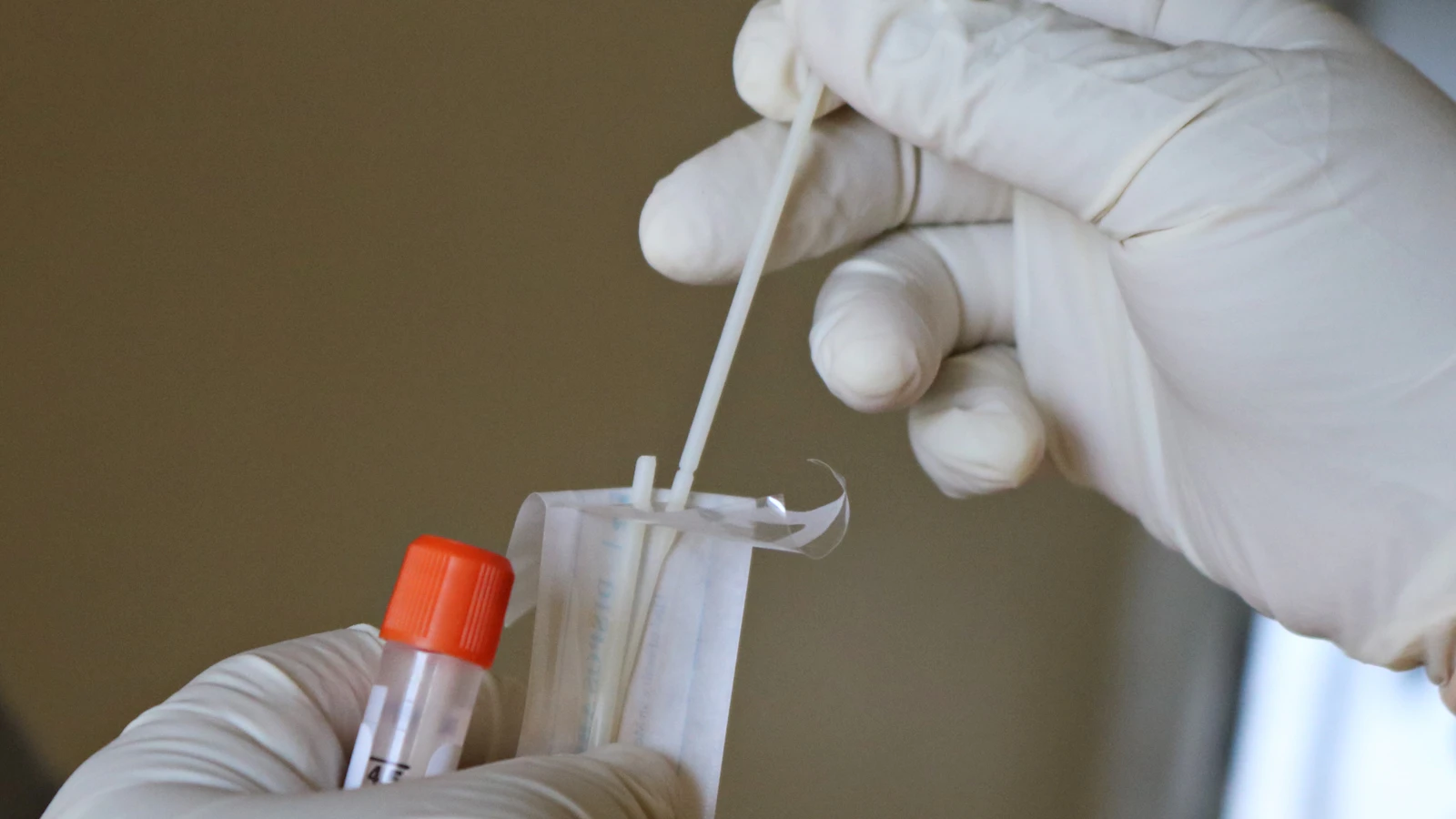
For the STI side, a PCR test. It looks for the genetic material of trichomonas, chlamydia and gonorrhoea in a swab or in urine. Bacterial vaginosis and candida are assessed differently, usually in the consulting room or the lab, and those two are not in a standard STI panel.
In women, the swab for the STI side can often be taken by yourself. That saves a conversation you may be dreading.
If you want the three most common bacterial and parasitic STIs checked in one go, a chlamydia, gonorrhoea and trichomonas test covers it. If you only want to rule out that one parasite, a separate trichomonas test is enough.
Worth knowing: a negative result does not rule out bacterial vaginosis or candida, because they were never in there. That sounds obvious, and it is still the most common thinking error on this topic.
How common is this in the Netherlands?
Bacterial vaginosis is the most common cause of changed discharge in women of reproductive age. Trichomonas is found less often in the Netherlands than chlamydia, but targeted testing does pick it up. The RIVM tracks Dutch STI diagnosis figures in its annual STI surveillance report.
The comparison is lopsided, because bacterial vaginosis is not centrally registered anywhere and trichomonas only appears when someone tested for it. What you see in the numbers therefore partly reflects how often people look.
Practically speaking: a condition being rarer says little about your situation. What matters is what is going on with you.
What does your GP do with these complaints?
Your GP can look, measure the acidity and send material to a lab if needed. When the three causes are hard to separate, that is where the distinction gets made. The NHG describes in its standard on vaginal complaints how that assessment looks in Dutch general practice.
Some people would rather not walk into their GP with this straight away. We understand that, and that is why you can first get the STI side checked anonymously.
What a test does not do is fill in the rest of the picture. If complaints persist while the STI result is negative, your GP remains the right person.
What if the complaints keep coming back?
With bacterial vaginosis, recurrence is closer to the rule than the exception. Bradshaw and colleagues followed women for a year after a course of metronidazole and saw a large share develop complaints again within twelve months. That is frustrating, and it does not mean you did something wrong.
Repetition does raise another question. If you get the same complaints three times a year and reach for the same over-the-counter gel three times, the odds that your assumption is right have not grown with the repetition. They stayed exactly what they were the first time.
What I find most striking here is how often the same step gets repeated without anything new being worked out.
When complaints keep returning, working it out properly once pays off more than a fourth course on instinct. That can mean ruling out the STI side with a PCR test first, and letting your GP assess the rest.
The Farmacotherapeutisch Kompas describes which agents are usual for bacterial vaginosis and for trichomonas. Those agents differ, which is one more reason to know what you are dealing with first.
What your partner has to do with this
With trichomonas it is standard for the partner to be treated too, because passing it back and forth otherwise happens easily. With bacterial vaginosis and candida that is different and the partner is usually not treated. That difference explains why the first question, is this an STI, carries so much weight.
Then the question that often stays unspoken. Does trichomonas mean someone cheated?
Not automatically. An infection can go unnoticed for a long time, certainly in men, so the moment of diagnosis says little about the moment of transmission. We worked that question out separately in trichomonas without sexual contact.
What you can do next
If your discharge changed with itching and there was no risk moment, your GP or chemist is a logical first step. If there was a risk moment, rule out the STI side with a PCR test before you start on self-care. That order stops you treating an infection you do not have while leaving one you do.
Also look at how discharge and STIs relate, and which STI tests exist for women.
Every blood test result includes a professional assessment from a BIG-registered doctor. For treatment decisions, discuss your results with your GP.
References
- Peebles K, et al. High Global Burden and Costs of Bacterial Vaginosis: A Systematic Review and Meta-Analysis. Sexually Transmitted Diseases, 2019. PMID: 30624309
- Muzny CA, Schwebke JR. Pathogenesis of Bacterial Vaginosis: Discussion of Current Hypotheses. The Journal of Infectious Diseases, 2016. PMID: 27449868
- Amsel R, et al. Nonspecific vaginitis. Diagnostic criteria and microbial and epidemiologic associations. The American Journal of Medicine, 1983. PMID: 6600371
- Sutton M, et al. The prevalence of Trichomonas vaginalis infection among reproductive-age women in the United States, 2001-2004. Clinical Infectious Diseases, 2007. PMID: 17968828
- Schwebke JR, Burgess D. Trichomoniasis. Clinical Microbiology Reviews, 2004. PMID: 15489349
- Vodstrcil LA, et al. Treating male partners of women with bacterial vaginosis (StepUp): a protocol for a randomised controlled trial. BMC Infectious Diseases, 2020. PMID: 33176727
- Bradshaw CS, et al. High recurrence rates of bacterial vaginosis over the course of 12 months after oral metronidazole therapy. The Journal of Infectious Diseases, 2006. PMID: 16652274
- RIVM, sexually transmitted infections in the Netherlands, annual surveillance report
- NHG, standard on vaginal complaints (fluor vaginalis)
Author
Discreettest
Dr. Naimi, BIG-registered physician, oversees the medical standards behind our content and assessments. Read our medical policy