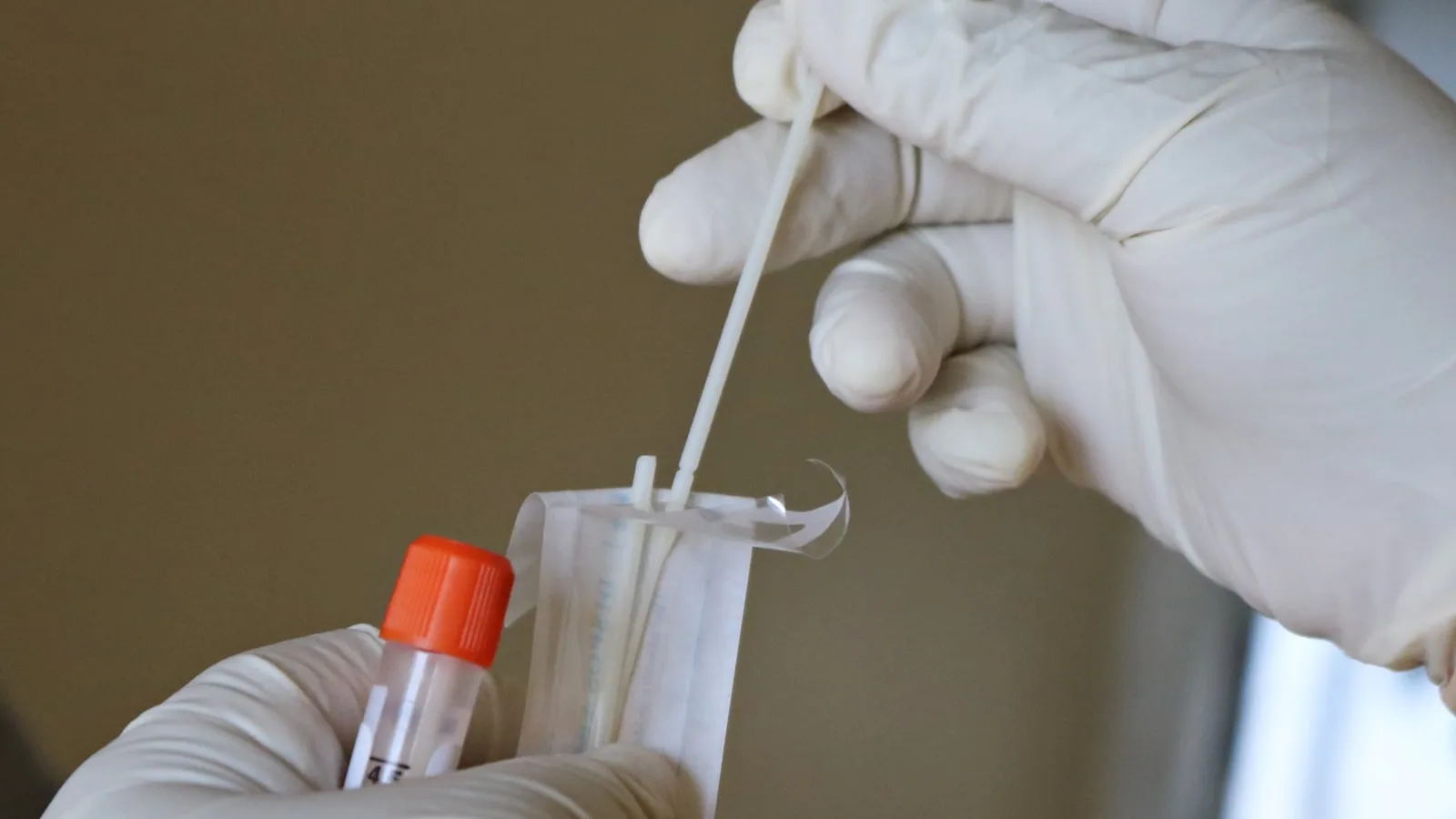
You went through something and you just want to be sure everything is fine, but you would rather not sit in your GP waiting room or explain yourself at a front desk. Fair enough. The question that follows is almost always the same: can you check yourself at home just as well, and does it truly stay private? The answer depends on which route you pick.
Let me be clear up front: not every home test is equal. The difference between a test you post to a laboratory and a rapid test you read yourself off a line largely decides how reliable your results are. Mix the two up and you can be falsely reassured.
Below I line the routes up side by side: the home test from other providers, the GGD, the GP, and the route we use ourselves.
How it works with us
Worth knowing up front: we do not post you a kit, and you do not collect a sample at home with us. You order online without a referral, visit an ordinary collection point near you, show the barcode on your phone and bring valid ID. Trained staff take the sample, an accredited lab analyses it, and your result appears in your own secure environment, reviewed by a doctor.
It is an ordinary collection point: no STI clinic, no sign on the door. Your test does not run through your GP and does not enter your medical record, but it is not fully anonymous either: we need your name and date of birth, as any reliable lab test does.
Want to get started right away? You can put together your own STI test without a referral.
Can an STI test at home be just as reliable?
Yes, as long as your sample goes to a laboratory. For chlamydia and gonorrhoea, self-collection reaches a sensitivity around 90 percent in comparative research, similar to collection by a health worker (PMID 26168051). When you test matters more than where you test.
For chlamydia and gonorrhoea, a good laboratory uses a PCR or NAAT test that detects the genetic material of the bacterium. The RIVM describes these nucleic acid amplification tests as the standard, precisely because they are sensitive and specific. Your GP orders the same class of test.
So the distinction that really matters is not home versus location, but lab versus reading it yourself.
Home test, collection point or GGD: the comparison
There is no single best route. It depends on how much privacy you want, how quickly you need results, and whether you have symptoms. The table below lines up the common options on cost, waiting time, privacy and reliability so you can make an informed choice.
| Route | Cost | Wait for result | Privacy | Reliability |
|---|---|---|---|---|
| Self-collection at home and post (other providers) | Fixed price, self-paid | Usually within 2 working days | High: no GP record | High with lab analysis, sensitive to collection and transport errors |
| Instant self-test, read it yourself (shop or webshop) | Low per unit | Immediate, but less certain | High | Variable: sensitive to collection errors and the window |
| Collection point after online order (our route) | Fixed price, self-paid | Usually within 2 working days | High: separate from your GP, but name and ID needed | High: professional collection, controlled chain to the lab |
| GGD STI clinic | Free if you qualify | Variable, sometimes a waiting list | Limited: registration with the GGD | High |
| GP | Your insurance excess | Appointment plus lab time | Low: goes into your medical record | High |
Want the GGD and a home test lined up point by point? I work that out in the comparison between the GGD, a collection point and a home test. And the exact prices per route are in STI test cost: what you pay and whether it is reimbursed.
What makes a result reliable?
Reliability rests on three things: the technique, correct collection and the right moment. For chlamydia and gonorrhoea, lab analysis by PCR is the gold standard. An instant self-test you read yourself often uses a different technique and is more prone to errors.
Self-collection is not automatically the weak link many people fear. An updated meta-analysis in women shows that self-collection and health-worker collection track closely in accuracy (PMID 38714714). The advantage of collection on site lies elsewhere: trained staff who take the sample properly first time, and a controlled chain to the lab rather than a tube sitting in a letterbox over a warm weekend.
What to watch: a faint line or too small a sample can give a false negative with a self-read test. Reliable HIV self-tests exist, but they have a longer window period than a lab test, so an early result says less. If you want real certainty, a sample that goes to a laboratory is the safer choice.
Small details decide whether your result holds.
The window period: the mistake everyone makes
Testing too early gives a false-negative result. Every infection has its own period between exposure and detectability. Thuisarts.nl points out that an STI test only makes sense once this period has passed. As a guide, you can test for chlamydia and gonorrhoea after about two weeks, while HIV and syphilis can take longer.
Want this worked out per infection? Read how long after sex you can test. And how long you then wait for your result is covered in STI test results: how long you have to wait.
Why we collect at a location
Because it removes the variable you have least control over. With self-collection at home, quality depends on whether you follow the instructions exactly and on how long your sample spends in transit. A randomised trial with postal kits showed that home sampling genuinely works and nearly doubles the number of people who get tested (PMID 29281628), so it is a serious route. But it is a route with more steps where something can go wrong.
At a collection point, trained staff take the sample and it enters the controlled chain to the lab straight away. You give something up for that: you have to go somewhere, and you show valid ID. What you get back is a result with no collection or transport error in it, with a doctor's assessment alongside.
Which STI test do you choose?
If you took a concrete risk, for example sex with a new partner without a condom, a broader panel is often wiser than a single test. An STI screen for chlamydia, gonorrhoea and trichomonas covers the most common bacterial infections at once.
Unsure between single tests and a full panel? The guide which STI test you need when helps you further. With a specific suspicion, a chlamydia check or an HIV check on its own may be enough. And to see step by step how ordering works, read how an anonymous STI test works.
How does your STI test stay out of your record?
With a test you order and pay for yourself, your GP is not involved, so nothing goes into your GP record and your health insurer sees nothing. That self-tests and low-threshold routes make testing more accessible without harming reliability also comes out of a large review (PMID 34278282).
Want to know exactly what is registered where? Read whether an STI test enters your medical record. And if you cannot get in anywhere without a wait, an STI test without an appointment is often the fastest way, or you choose a place to test discreetly.
A check is a normal part of taking care of your health. How you arrange it is entirely your choice.
What does an STI test without a referral cost and is it worth it?
An STI test without a referral has a fixed price that you pay yourself. So you know in advance where you stand, without an excess or an unexpected bill afterwards. What you pay exactly depends on whether you pick a single test or a broader panel.
Whether it is worth it depends on what privacy and speed are worth to you. If you qualify for free testing at the GGD and you are not in a hurry, that is cheaper. If you want to test without a wait, without an appointment and without registration at the GGD, you pay for that convenience. The full price comparison per route is in the overview on costs.
What is an STI test not suitable for?
An STI test on blood or urine is strong for the most common STIs, but not for everything. Visible symptoms such as blisters, warts or sores need a doctor to look, because you do not establish those with a sample. With severe pain, fever or symptoms that keep lingering, a consultation is wiser than testing yourself.
A standard panel also does not automatically test for every infection. Herpes and HPV are usually not in a regular STI check, and whether a test for mycoplasma or hepatitis is useful depends on your situation. So choose your panel based on your risk, not on a hunch. If you are unsure what fits, plain information or a quick word with a doctor is never wrong.
When do you still choose the GP or GGD?
With symptoms that will not go away, a known exposure to a specific STI, or if you are under 25 and the GGD tests you for free, the regular route can be more logical. The GGD can also help with partner notification and with treatment on site, something a standalone test does not offer.
If you test positive, treatment and sometimes further testing always follow. A test gives you the result, but you arrange the next step with a doctor. That way you are sure an infection is actually treated and does not go unaddressed.
How to order and pay discreetly
Discreet testing starts with how you order and pay. You need no referral and no GP appointment. You choose a panel online, pay yourself, and visit the collection point that suits you. A neutral description appears on your bank statement.
Because no claim goes to your health insurer, your test stays off your insurance overview. To see step by step how that process works, read how an anonymous STI test works.
Frequently asked questions
Does the collection hurt?
Barely. Catching a urine sample does not hurt, and a blood draw feels like a short prick. You are usually done at the location within about fifteen minutes.
How quickly do I get my results?
With a sample that goes to the laboratory, you usually have clarity within two to three working days. A self-read test gives an immediate indication, but is less certain than a lab result.
Does my health insurer see that I get tested?
No, if you pay for the test yourself nothing runs through your insurance. Nothing enters your GP record either.
Can I test together with my partner?
Yes, you can and it is often wise. You order two checks and visit a collection point together, or separately at a moment that suits each of you.
Do I get a test kit posted to me?
No. We do not send out kits and you do not collect a sample at home with us. You visit an ordinary collection point, where trained staff take the sample.
What if my result is positive?
A positive result means you can be treated, usually simply. You arrange treatment with a doctor or the GGD, and your partner from the recent period gets checked too.
How reliable is a home test really?
For chlamydia and gonorrhoea, lab analysis of a home sample is as reliable as collection on site, as long as you test at the right moment and follow the instructions. The difference is mainly in how many steps can go wrong.
Do I need to fast for an STI test?
No, fasting is not needed. For a urine sample the only request is that you do not urinate for a while before collection, so there is enough material.
Sources
- Lunny C, et al. Self-Collected versus Clinician-Collected Sampling for Chlamydia and Gonorrhea Screening: A Systematic Review and Meta-Analysis. PLoS One. 2015. PMID 26168051.
- Jaya ZN, et al. Accuracy of self-collected versus healthcare worker collected specimens for diagnosing sexually transmitted infections in females: an updated systematic review and meta-analysis. Scientific Reports. 2024. PMID 38714714.
- Jamil MS, et al. Examining the effects of HIV self-testing compared to standard HIV testing services in the general population: a systematic review and meta-analysis. EClinicalMedicine. 2021. PMID 34278282.
- Johnson CC, et al. Examining the effects of HIV self-testing compared to standard HIV testing services: a systematic review and meta-analysis. Journal of the International AIDS Society. 2017. PMID 28530049.
- Wilson E, et al. Internet-accessed sexually transmitted infection (e-STI) testing and results service: a randomised, single-blind, controlled trial. PLoS Medicine. 2017. PMID 29281628.
- RIVM. Sexual health and STIs: information and guidelines. rivm.nl.
- Thuisarts.nl / NHG. I want to get tested for an STI.
An STI test can confirm or rule out an infection, but it does not replace a consultation. Our results are reviewed by a doctor, and with symptoms, doubt or a positive result you should talk to a doctor or the GGD.
Autor
Discreettest
Dr. Naimi, lekarz wpisany do holenderskiego rejestru BIG, nadzoruje standardy medyczne naszych treści i ocen. Przeczytaj naszą politykę medyczną