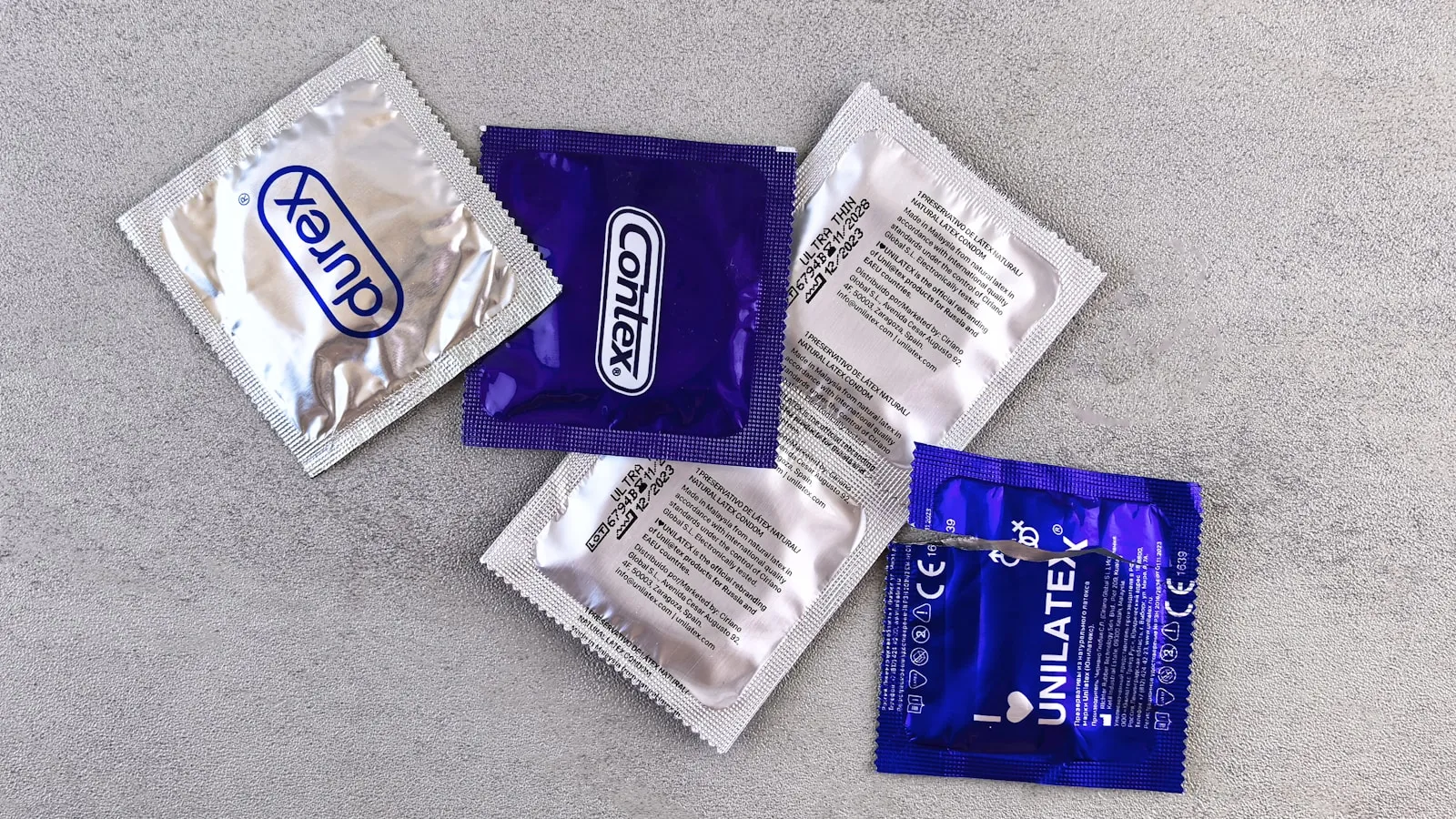
Safe sex means making the chance of an STI as small as possible, not making it zero. With consistent use, a condom goes together with about 80 percent fewer HIV infections, but with about 30 percent fewer herpes infections. That gap of 50 percentage points tells you the whole story.
Some STIs sit in body fluids. Others sit on the skin around them, and that is where a condom stops.
Below are eight ways to lower the risk. For each one you also read what it does not cover, because that second part is what most tip lists leave out.
- A condom for vaginal and anal sex
- A condom or dental dam for oral sex
- Water-based lubricant
- Cleaning or covering sex toys
- Vaccination against HPV and hepatitis B
- PrEP when your HIV risk is raised
- PEP within 72 hours of a risk moment
- Getting checked together before you stop using condoms
What is safe sex?
Safe sex is anything that limits the exchange of body fluids and direct skin contact, so an STI gets less chance to pass on. In practice that means barriers such as condoms, vaccinations, medication such as PrEP, and knowing where you stand. No single method covers everything.
It helps to split STIs into two groups. Chlamydia, gonorrhoea, trichomonas, HIV and hepatitis B travel with fluid: semen, pre-ejaculate, vaginal fluid, blood. Herpes, HPV and syphilis can also pass on through skin-to-skin contact.
That split explains almost everything that follows.
According to Thuisarts.nl, STIs regularly run without symptoms, so someone can pass an infection on without knowing (thuisarts.nl). Safe sex is therefore rarely about distrust. Usually it is about something nobody could see.
1. A condom for vaginal and anal sex
A condom is the only method on this list that slows several STIs at once and also prevents pregnancy. A Cochrane review found about 80 percent fewer HIV infections with consistent use than with never using one (Weller and Davis, 2002). For chlamydia, gonorrhoea and trichomonas the same principle applies.
Consistent is the key word here. That same research looked at people who used one every time, not most times.
In practice four things matter: check the expiry date, squeeze the air out of the tip, use one per act, and do not keep them for months in your pocket or wallet. Friction and heat weaken latex.
How a condom compares with PrEP and PEP is something we set side by side in our article on prevention methods compared.
2. A condom or dental dam for oral sex
Oral sex feels like the safe option to many people, but gonorrhoea, chlamydia and syphilis can settle in the throat. A throat infection often causes no symptoms, so you usually notice nothing. A condom during oral sex, or a dental dam for licking and rimming, lowers that risk.
A dental dam is a thin sheet of latex you place between the mouth and the vulva or anus. A condom cut open lengthways does the same job.
Let us be honest: this is the point where most people opt out. I rarely see it happen outside a clinic room.
What does and does not pass on through oral contact is something we describe in this article about oral sex, a toilet seat and a towel.
3. Water-based lubricant
Lubricant prevents no STI on its own. It lowers something else: the chance that a condom tears, and the chance of small tears in the mucous membrane, where an infection gets in more easily. Choose water-based or silicone, because oil and fat break down latex.
That means no body lotion, no baby oil, no coconut oil and no massage oil with a latex condom.
For anal sex this weighs heavier, because the bowel wall produces no lubricant of its own. Using plenty makes the most difference there.
4. Cleaning or covering sex toys
A sex toy that moves from one person to another can carry fluid with it. Trichomonas, chlamydia and gonorrhoea can reach a second person this way, and herpes and HPV can travel through skin contact with the toy. A fresh condom per person solves most of it.
Without a condom: warm water and soap, then dry it properly.
This sounds like a detail. In practice it is the cheapest step on this entire list.
5. Vaccination against HPV and hepatitis B
Two STIs on the list have a vaccine: HPV and hepatitis B. A vaccination works beforehand and does not protect against the other STIs. Whether a vaccination fits your situation is something you discuss with your GP or the GGD, because it depends on your age and earlier doses.
HPV is a special case here. The virus is the most common STI worldwide, and yet an ordinary STI test on blood or urine usually does not find it.
Why that is so is something we explain in our article on HPV and why an STI test does not find it.
6. PrEP when your HIV risk is raised
PrEP is medication you take beforehand to prevent an HIV infection. In the iPrEx study, new HIV infections in the PrEP group ran 44 percent lower than in the placebo group, measured across everyone who took part (Grant et al., 2010). Among participants who actually took the pills, that effect ran higher.
PrEP works against HIV only. Chlamydia, gonorrhoea and syphilis pass it by.
It is prescription medication, so your GP or the GGD assesses whether it fits your situation. What it involves is covered in what PrEP is and who it makes sense for.
7. PEP within 72 hours of a risk moment
PEP is the course you take afterwards. It has to start within 72 hours of the risk moment, and sooner is better. You arrange it through a GP, the GGD or the emergency department, not through a web shop, and again it covers HIV only.
Those 72 hours are a hard limit. After that, this medication is no longer on the table.
If you are in that situation, our article on PEP after unprotected sex takes you further.
8. Getting checked together before you stop using condoms
The moment a couple stops using condoms is exactly the moment the risk changes. Some couples choose to both get checked before that, so they know where they stand. Chlamydia, gonorrhoea and trichomonas can be checked together in one go.
For many people the conversation about it is more awkward than the test itself.
We wrote a separate article about it: testing together in a new relationship. Want to see what gets checked, then look at the chlamydia, gonorrhoea and trichomonas check.
Can you get an STI while using a condom?
Yes, you can. A condom covers what it sits over, and that is exactly enough for infections that travel through fluid. Herpes, HPV and syphilis can also sit on the skin next to it: the scrotum, the groin, the pubic area. A condom covers none of that.
The figures show that difference well. Among women whose partner always used a condom, HPV occurred at 37.8 per 100 patient-years, against 89.3 with little use (Winer et al., 2006). For herpes, the risk at 100 percent use ran about 30 percent lower (Martin et al., 2009).
Eighty percent, seventy percent, thirty percent. The same condom three times, a different number three times. I think that spread is the most useful thing to know about condoms, because it shows you where the leftover risk sits.
| Method | Mainly lowers the risk of | Covers little or not at all |
|---|---|---|
| Condom for vaginal and anal sex | HIV, chlamydia, gonorrhoea, trichomonas, hepatitis B | Herpes, HPV and syphilis on the skin next to it, pubic lice |
| Condom or dental dam for oral sex | Gonorrhoea, chlamydia and syphilis in the throat | Skin contact around the mouth and pubic area |
| Water-based lubricant | Tears and small wounds in the mucous membrane | No STI on its own |
| Cleaning or covering a sex toy | Transmission through fluid on the toy | Skin-to-skin contact between partners |
| HPV vaccination | The HPV types in the vaccine | All other STIs |
| Hepatitis B vaccination | Hepatitis B | All other STIs |
| PrEP | HIV | All other STIs |
| PEP within 72 hours | HIV after a risk moment | All other STIs |
| Getting checked together | Unexpected results when you stop using condoms | What happens after the test |
Want to know which STIs go around in the Netherlands, then we list them in 9 STIs that occur in the Netherlands.
Can you have safe sex without a condom?
You can lower the risk without a condom, but you cannot bring it to zero. Vaccination, PrEP, both knowing where you stand and not sharing sex toys each take something off. For infections that pass on through skin contact, a remainder always stays, however careful you are.
Kissing, stroking and masturbating together count as low-risk acts.
In 2024 the RIVM registered more than 20,000 chlamydia diagnoses at the Centres for Sexual Health, by far the most-found STI (RIVM). Those are only the cases that were found, so only the people who got checked.
What do you do when it goes wrong anyway?
Two people have the same Friday evening: the condom tears for both, but one calls on Saturday and the other waits 5 days. For the first, PEP is still an option, because those 72 hours are still running. For the second, that window has closed.
For the STI test itself, that difference changes nothing. Both of them wait out the window period, the stretch in which a test can show nothing yet.
That second clock runs differently per STI. Chlamydia and gonorrhoea are usually detectable after two weeks, HIV and syphilis take longer.
Testing too early mostly gives you a result you cannot use. How long you roughly need to wait is covered in how long after unprotected sex you can test.
Once you have waited that period out and want certainty, you can get checked on your own moment, for example with the viral infections package or the guide on which STI test you need and when. I think that is the real closing piece of safe sex: not guessing, just checking.
Sources
- Weller S, Davis K. Condom effectiveness in reducing heterosexual HIV transmission. Cochrane Database of Systematic Reviews (2002). PMID 11869658 (pubmed.ncbi.nlm.nih.gov)
- Winer RL et al. Condom use and the risk of genital human papillomavirus infection in young women. New England Journal of Medicine (2006). PMID 16790697 (pubmed.ncbi.nlm.nih.gov)
- Martin ET et al. A pooled analysis of the effect of condoms in preventing HSV-2 acquisition. Archives of Internal Medicine (2009). PMID 19597073 (pubmed.ncbi.nlm.nih.gov)
- Grant RM et al. Preexposure chemoprophylaxis for HIV prevention in men who have sex with men. New England Journal of Medicine (2010). PMID 21091279 (pubmed.ncbi.nlm.nih.gov)
- RIVM, Thermometer seksuele gezondheid, 2024 figures (2025) (rivm.nl)
- Thuisarts.nl, STI (2024) (thuisarts.nl)
Every blood test result includes a professional assessment from a BIG-registered doctor. For treatment decisions, discuss your results with your GP.
الكاتب
Discreettest
Dr. Naimi، طبيب مسجل في سجل BIG الهولندي، يشرف على المعايير الطبية لمحتوانا وتقييماتنا. اقرأ سياستنا الطبية
فحوصات ذات صلة
مقالات ذات صلة

How long is scabies contagious?

How do you get pubic lice? And does shaving help?