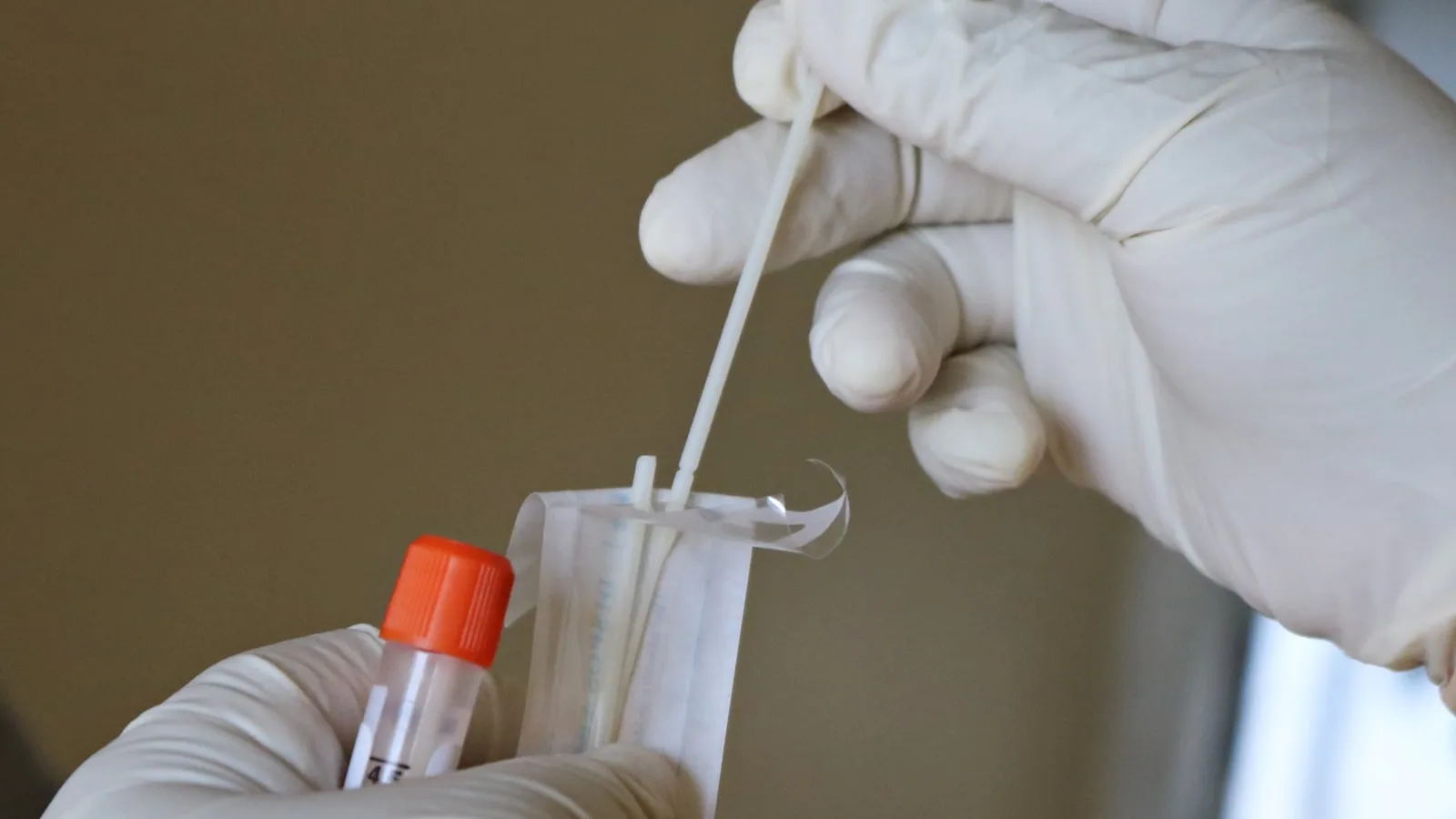
To test for a throat STI you need a swab of your throat, not urine or blood. For gonorrhoea and chlamydia in the throat, a cotton swab is wiped along the back of your throat and a laboratory examines it with a PCR. A throat swab you take yourself has proven in research to be almost as reliable as one taken in a clinic, with accuracy above 99 percent (Orser, 2024).
A throat STI test often causes anxiety: what happens exactly, does it hurt, and can you do it yourself. This article calmly explains how a throat swab works, why a normal urine or blood test skips your throat, and how reliable self-swabbing is. We are a testing provider, so we say honestly what a test does and does not show here.
How do you test for an STI in the throat?
You test for an STI in the throat with a throat swab. A cotton swab is wiped along the back of your throat and along the tonsils. The lab examines that sample with a PCR, a sensitive technique that detects the genetic material of gonorrhoea or chlamydia (Chan, 2016).
The key difference from a normal STI test is the location. A urine test looks at the urethra, a blood test at antibodies or the virus in your blood. Neither reaches your throat. If your risk or complaint sits in the throat, a separate throat swab is the only sample that can say anything about it.
The throat swab is usually not requested on its own, but as an extra sampling site alongside the genital test. That way the same test for chlamydia and gonorrhoea can be run on both the urethra and the throat. Our test for chlamydia, gonorrhoea and trichomonas shows those infections with a PCR; choose a throat swab when ordering if you want your throat checked specifically.
What exactly is a throat swab?
A throat swab is a sample where a sterile cotton swab is briefly wiped along the back of your throat and your tonsils. That swab collects some mucous membrane and cells, in which any throat infection with gonorrhoea or chlamydia would sit. The sample then goes to a laboratory for a PCR analysis.
A swab sounds more medical than it is. It is a few seconds in which the cotton swab touches the back of your throat. Some people get a brief gag reflex, similar to brushing your teeth too far back. That feeling usually passes quickly, and the swab only has to touch the throat for a moment.
The cotton swab differs from a throat culture you may know from an ordinary throat infection. With an STI the sample does not go onto a culture plate but into a PCR or NAAT, with which the lab detects the genetic material of the bacterium. For the throat, that molecular technique is considered more sensitive than a classic culture (Chan, 2016).
Can you test for a throat STI with urine or blood?
No, a urine test or blood test says nothing about your throat. A urine sample examines the urethra, and a blood test looks for STIs such as HIV or syphilis in your blood. A throat infection with gonorrhoea or chlamydia sits on the lining of your throat and is only detected with a throat swab.
This is exactly where many people test past the problem. Someone who only does a urine test after unprotected oral sex leaves out the spot where the risk sat. The result can then seem reassuring while the throat was never checked. A negative urine or blood test does not rule out a throat STI.
A throat infection with gonorrhoea also often gives no symptoms; in one cohort, 92 percent of throat gonorrhoea ran without symptoms (Morris, 2006). That is precisely why you cannot rely on how you feel, and why a throat swab is the only way to check the throat.
The table below sets out, per STI, what you test for in the throat, which sample goes with it, and whether it is in our CGT test. Look at the last column, because it shows that urine or blood says little about what is happening in your throat.
| STI | What you test for in the throat | Which sample | In the CGT test? |
|---|---|---|---|
| Gonorrhoea | Throat infection on the lining | Throat swab (PCR) | Yes, with a throat swab |
| Chlamydia | Throat infection on the lining | Throat swab (PCR) | Yes, with a throat swab |
| Syphilis | Antibodies, not the throat itself | Blood test | No, separate test |
| Herpes (HSV) | Blister or sore in the mouth | Swab of a blister | No, separate test |
| HIV | Virus in the blood, not the throat | Blood test | No, separate test |
Two things stand out. Only gonorrhoea and chlamydia in the throat are found with a throat swab. Syphilis, herpes and HIV need a different sample, and those are not in the CGT test. So urine or blood says nothing about the throat itself.
Thuisarts.nl and the RIVM also describe that an STI test is site-specific: you test at the spot where the risk was, so the throat separately from the genitals. That underlines why a urine or blood test does not pick up a throat infection.
Can you take a throat swab yourself at home?
Yes, in many cases you can take a throat swab yourself at home. You wipe the cotton swab along the back of your throat yourself and send the sample to the laboratory. Research shows that such a self-taken throat swab can give reliable results, comparable to a sample taken in a clinic (Orser, 2024).
For many people that is a relief. A home test means no waiting room, no conversation at a desk, and no trip to a clinic. You take the sample at a moment that suits you, package it according to the enclosed instructions, and send it off anonymously.
It does matter that you follow the instructions, because a throat swab that goes too lightly along the throat can collect less material. The study by Orser and colleagues found that self-taken throat and anal swabs were non-inferior to those from the care setting, but that held with a correct sample (Orser, 2024).
How reliable is a throat swab?
A throat swab examined with a PCR is considered a sensitive way to detect gonorrhoea or chlamydia in the throat. In research into self-taken throat swabs, accuracy was above 99 percent, comparable to a sample taken in a clinic (Orser, 2024). No test, however, gives absolute certainty.
The PCR or NAAT technique detects the genetic material of the bacterium and has proven more sensitive for the throat than a classic culture (Chan, 2016). That makes it the usual method for throat samples. Still, a reliable result also depends on the sampling and on the moment you test.
If you test too early after a possible risk, an infection can still be below the detection threshold. That has to do with the incubation time and the window period, which the next question covers. If you are unsure about a result, your GP can help you decide whether further steps are needed.
How long after the risk can you test for a throat STI?
After a possible risk, a throat infection needs time to become detectable. That period is called the window period or incubation time. For gonorrhoea and chlamydia it is usually about two weeks before a throat swab can reliably show anything. If you test earlier, an infection may still be missed.
The window period is the time between an infection and the moment a test can reliably pick it up. If you test within that period, the result can be negative while something is nonetheless present. That is why an early test says less than a test after the window period.
Exactly how long you wait differs per STI and per test. In how long after unprotected sex you can test we go into that in more depth. For a throat infection the same principle applies as for the genital variant: testing too early can miss an infection.
A throat swab on a Friday evening
Say someone had unprotected oral sex with a new partner two weeks ago. No complaints, no sore throat, nothing unusual. Still the question keeps nagging: did something stay behind in the throat. An ordinary urine test would not check the throat, so that feels like the wrong test.
This person chooses a throat swab and takes it at home, at a quiet moment on a Friday evening. The cotton swab briefly touches the back of the throat, a short gag reflex, and it is done. The sample goes off anonymously in the post. No waiting room, no conversation at a desk.
Whatever the result turns out to be, the test now does look at the spot where the risk sat. That is the difference: it is not the feeling in the throat that guides the choice, but what happened around it. And only a throat swab can say something about that spot.
Further reading
If you first want to know which STIs can actually sit in your mouth and throat, read oral and throat STIs. If you feel nothing but the doubt remains, a throat STI without symptoms takes you further, and for that one infection there is chlamydia in the throat.
If you want to test specifically for chlamydia and gonorrhoea, you will find more at our test for chlamydia, gonorrhoea and trichomonas. On testing at home in general, read STI test at home and anonymous STI test. And for the timing: how long after unprotected sex you can test.
References
- Orser L, et al. Testing for extragenital Neisseria gonorrhoeae and Chlamydia trachomatis: At-home pharyngeal and rectal self-swabs are non-inferior to those completed in healthcare settings. PLoS One, 2024. PMID 38768150.
- Chan PA, et al. Extragenital Infections Caused by Chlamydia trachomatis and Neisseria gonorrhoeae: A Review of the Literature. Infectious Diseases in Obstetrics and Gynecology, 2016. PMID 27366021.
- Morris SR, et al. Prevalence and incidence of pharyngeal gonorrhea in a longitudinal sample of men who have sex with men: the EXPLORE study. Clinical Infectious Diseases, 2006. PMID 17051493.
- RIVM, STI surveillance Netherlands. Accessed July 2026.
- Thuisarts.nl, I want to get tested for an STI. Accessed July 2026.
Every blood test result includes a professional assessment from a BIG-registered doctor. For treatment decisions, discuss your results with your GP.
Author