A herpes test comes in two forms. If you have a blister right now, a PCR swab of that spot is the test of choice. If you have no symptoms, a blood test measuring antibodies is what remains, and it answers a far narrower question than most people expect.
I say that up front, because nearly all the confusion starts here. People order a blood test while they have an active lesion, or they expect an answer from an IgG result that simply is not in it.
Below we set it out per situation. For the complete picture of the infection, read our overview of genital herpes.
Which herpes test do you need?
That depends entirely on whether you can see or feel something right now. Visible symptoms call for a PCR swab, because then the virus itself can be detected. No symptoms means only a blood test remains, and that tells you something else: whether you ever made antibodies.
The table below is the shortest summary we can offer.
| Your situation | Test of choice | Where |
|---|---|---|
| You have a blister or sore now | PCR swab of the spot | GP or Centre for Sexual Health |
| No symptoms, your partner has herpes | HSV-1 and HSV-2 IgG in blood | Discreet Test or your GP |
| Symptoms are gone, you want to know what it was | IgG in blood, with reservations | Your GP |
| No symptoms, no concrete reason | Usually no herpes test | A regular STI check instead |
That last line surprises people. It is the sober truth though, and RIVM and Dutch STI practice reason the same way: broad screening for herpes antibodies without symptoms yields little and causes a lot of worry.
What does a herpes blood test measure?
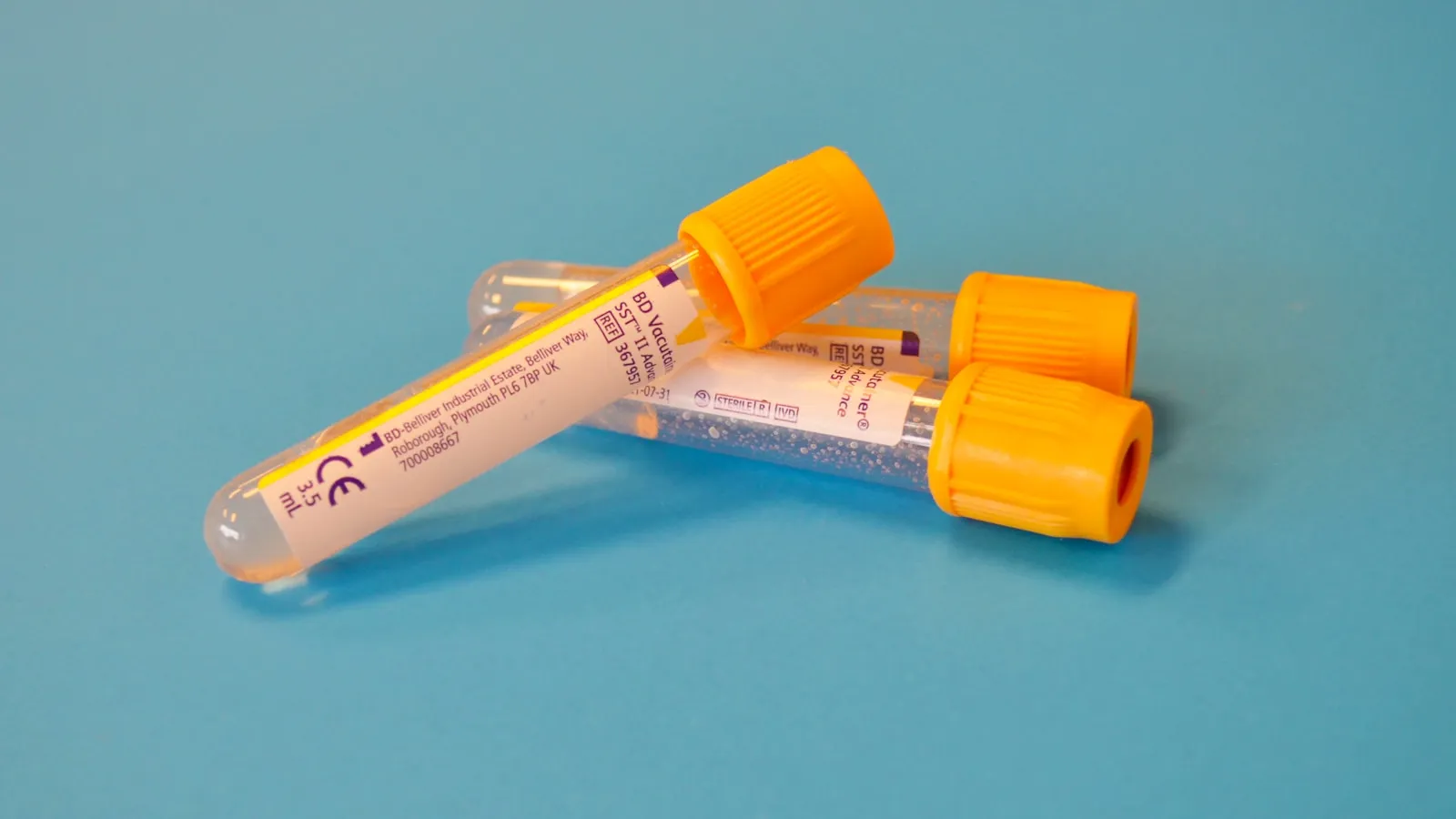
A herpes blood test measures IgG antibodies, separately for HSV-1 and HSV-2. Your body makes them after meeting the virus, and they stay measurable for life. So the test looks at your immune system, not at the virus itself.
That explains the limits. An IgG cannot see where the virus sits, when you caught it, or whether you are contagious today. With us you can test HSV-1 IgG and HSV-2 IgG separately and add them to your own test, because they are not part of the standard STI packages.
About IgM, the other antibody you sometimes come across: in practice it helps little. An IgM is poor at dating an infection and can also rise when an old infection flares up.
How reliable is a herpes test?
PCR on a fresh blister is the most reliable route there is. It finds the virus clearly more often than the older culture, which is why PCR is the test of choice as soon as something is visible (LeGoff et al., 2014). The blood test is less sharp, and that comes down to timing and interpretation.
A swab from a blister that is already drying out can come back negative while you do have herpes. Fresh beats complete. So do not wait a week.
With the blood test, a borderline result is the hardest case. Such a barely-positive value often needs a second measurement or a different test, and that is exactly the kind of result you do not want to work out alone. Our doctor reviews every result, and refers you on when in doubt.
When is a negative result reliable?
Only once your body has had time to build antibodies. That usually takes several weeks to a few months, and it differs per person. Testing too early gives you a negative result that rules nothing out, which is riskier than not testing, because you sit back reassured for the wrong reason.
Picture testing HSV-2 IgG 3 weeks after a risk moment and getting a negative back. It feels reassuring, but the antibodies may simply not be there yet. A repeat at around 12 weeks gives a far firmer answer.
How that timing works exactly is in herpes incubation period. For the other STIs, how long after unprotected sex you can test helps.
What if your result is positive?
A positive IgG means you caught the virus at some point. It says nothing about the location, the moment, or whether you will get symptoms. Many people with a positive HSV-1 have never had anything other than a cold sore, and notice nothing else.
That is not playing it down. In a study of more than 3,400 young women, 74 percent of first HSV-1 infections ran without recognised symptoms (Bernstein et al., 2013). With herpes, unnoticed is the rule and not the exception.
What it means for contagiousness is more nuanced: even without blisters the virus is present now and then, in people without symptoms on about 10.2 percent of days (Tronstein et al., 2011). The difference between the two types decides how heavily you weigh this, and we work that out in cold sore or genital herpes.
What is your next step?
Seeing something now? Then go to your GP or a Centre for Sexual Health today and ask for a PCR swab. Do not wait until the blister has dried out, because the test loses its edge. Thuisarts.nl explains what to expect at that appointment.
No symptoms, but a reason to know where you stand? Then you can test HSV-1 and HSV-2 separately with us and view the result anonymously. How that route works is in the anonymous STI test.
Sources
- LeGoff J, Pere H, Belec L. Diagnosis of genital herpes simplex virus infection in the clinical laboratory. Virol J. 2014;11:83. PMID 24885431.
- Bernstein DI, Bellamy AR, Hook EW, et al. Epidemiology, clinical presentation, and antibody response to primary infection with herpes simplex virus type 1 and type 2 in young women. Clin Infect Dis. 2013;56(3):344-351. PMID 23087395.
- Tronstein E, Johnston C, Huang ML, et al. Genital shedding of herpes simplex virus among symptomatic and asymptomatic persons with HSV-2 infection. JAMA. 2011;305(14):1441-1449. PMID 21486977.
- RIVM. STI guidelines and sexual health surveillance. Available via rivm.nl.
- Thuisarts.nl (NHG). I think I have an STI. Available via thuisarts.nl.
This information is general and does not replace personal medical advice. Every STI test result at Discreet Test is reviewed by a BIG-registered doctor. Always discuss symptoms or treatment decisions with your GP, the GGD or a Centre for Sexual Health.
Autor
Discreettest
Dr. Naimi, lekarz wpisany do holenderskiego rejestru BIG, nadzoruje standardy medyczne naszych treści i ocen. Przeczytaj naszą politykę medyczną