Dry, flaky or itchy patches on the glans are rarely an STI. Usually it is just skin. In an Australian clinic that saw 331 men with genital skin complaints, the most common diagnoses were contact irritation (67), dysaesthesia (60), psoriasis (31) and eczema (16). Genital warts appeared 18 times (Bunker, 2017).
Add up those first four and you land far above anything sexually transmitted.
Yet people with this complaint end up with us, not with a dermatologist. We get it: it sits in a place that makes you think of sex immediately. Below you will read how to tell skin from STI, and why you should look elsewhere on your body.
Can you get eczema on your glans?
Yes. The skin of the glans and foreskin is ordinary skin, so it can get anything skin can get: eczema, psoriasis, contact allergy, irritation. Sitting on your genitals does not make it sexual. It only makes it more sensitive, because the skin there is thinner and sits enclosed, warm and damp.
The strongest clue is usually not on your glans.
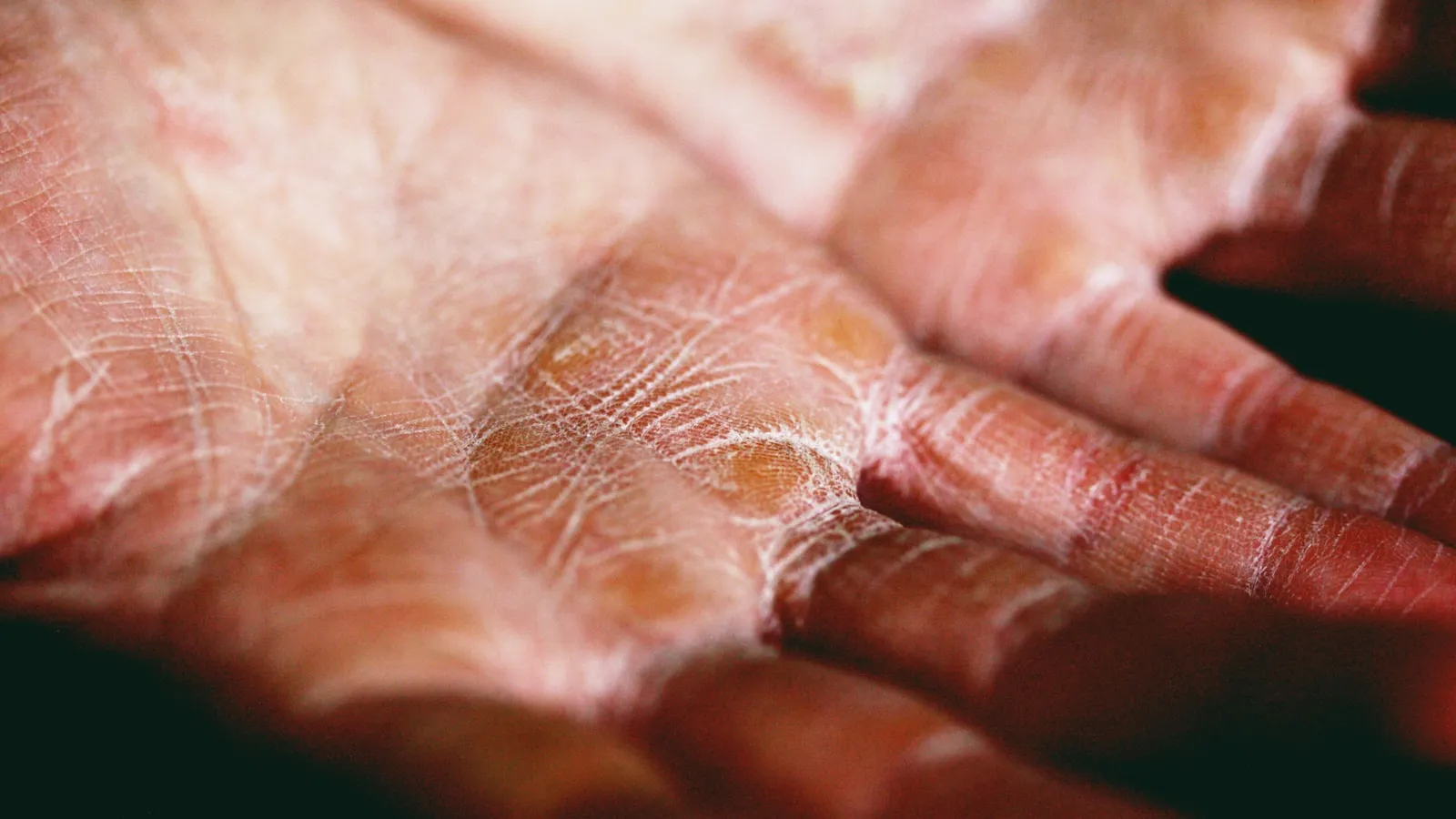
That same Australian series found a striking link with atopy, the predisposition to eczema, hay fever and asthma (Bunker, 2017). If you had eczema as a child, or you have dry patches in your elbow creases or behind your knees now, that is more relevant than how the patch on your glans looks. Skin behaves the same way everywhere.
So look beyond the spot that worries you.
How do you tell it apart from an STI?
By the course, and by the rest of your body. Skin complaints come and go, itch more than they hurt, and often follow a traceable trigger. STI complaints usually have a moment of transmission, come from the urethra more often, and cause discharge or pain sooner than flaking.
The table below sets it side by side.
| What you notice | Fits | What an STI test can do here |
|---|---|---|
| Dry, flaky, itchy patch, also elsewhere on your body | Eczema or psoriasis | Nothing. This is dermatology |
| Sharply bordered patch, appeared after new soap or lubricant | Contact irritation or allergy | Nothing. This is a skin reaction |
| Whitish, hardened patches, foreskin tightening | Lichen sclerosus | Nothing. GP or dermatologist |
| Painful blisters appearing in clusters | Herpes | Needs a separate herpes test |
| Wart-like bumps | HPV | Nothing. No STI test finds HPV |
| Discharge from the urethra, pain when peeing | Urethritis | Chlamydia, gonorrhoea and trichomonas are detectable |
One row out of six falls within what we test. That is exactly why we write this page: if your complaint falls in the top three rows, an STI test costs you money and gives you no answer.
Why does everyone think STI first?
Because the location takes over the thinking. The same dry patch on your elbow is an annoyance; on your glans it is a moment of panic. We see that in what people ask us, and it is human.
Still, that reflex regularly sends people the wrong way.
The 2026 British guideline describes glans and foreskin complaints as a spectrum of infective, inflammatory, premalignant and systemic conditions, and names both identifying an STI and avoiding unnecessary antibiotics as reasons for an accurate diagnosis (BASHH, 2026). Both halves of that sentence matter. Missing an STI is a problem, but treating a skin condition as an infection for months is one too.
That last risk is not theoretical. A 2026 review shows that lichen sclerosus in men is regularly reported as candidal balanitis, including by clinicians, and that it can cause scarring and lasting damage (Kravvas, 2026).
So when is an STI test useful?
When there has been unprotected contact you still know nothing about, or when discharge from the urethra is part of the picture. Then it is no longer about your skin, but about a question you can only answer with a test. Those two can be in play at once, and it helps to handle them separately.
Your skin and your STI question are two separate conversations.
Take two men of 27 with the same flaky patch. One had eczema as a child and now has dry patches in his elbow creases too. The other has never had skin trouble, but does have discharge as well and had unprotected contact 10 days ago. My point: the same patch, and yet one question is dermatology and the other is a test.
Our test for chlamydia, gonorrhoea and trichomonas shows those three with a PCR and closes that question. For your dry patch you need a GP. Which test fits which complaint is covered in which STI test you need when.
What can you do yourself?
Thuisarts.nl, the patient platform of the Dutch College of General Practitioners, describes the basics as rinsing with water, a few times a day, without soap. If complaints do not lessen after a few days, ask your GP for advice. With dry skin, dropping soap is often half the work, because soap dries the skin barrier out further.
What we do not do is recommend you a cream. That is your GP's call.
If it keeps returning in the same spot, that points towards skin rather than infection. That is a conversation for your GP, who can refer you to a dermatologist if needed.
Further reading
The full overview of causes is in balanitis. If redness is your main complaint, go to red glans. If you see white coating, read yeast on the glans. If it is a bump rather than a patch, bumps or blisters on your genitals helps.
References
- Bunker CB, et al. Skin disease of penis and male genitalia is linked to atopy and circumcision: caseload in a male genital dermatology clinic. Australasian Journal of Dermatology, 2017. PMID 27170096.
- BASHH national guideline on the management of balanoposthitis (and related penile skin conditions), International Journal of STD & AIDS, 2026. PMID 42216889.
- Kravvas G, et al. Male genital lichen sclerosus misreported as candidal or other infective balanitides: a systematic review of the literature. International Journal of STD & AIDS, 2026. PMID 41026603.
- Thuisarts.nl, Ontstoken eikel. Accessed July 2026.
Every blood test result includes a professional assessment from a BIG-registered doctor. For treatment decisions, discuss your results with your GP.
الكاتب
Discreettest
Dr. Naimi، طبيب مسجل في سجل BIG الهولندي، يشرف على المعايير الطبية لمحتوانا وتقييماتنا. اقرأ سياستنا الطبية
فحوصات ذات صلة
مقالات ذات صلة

How long is scabies contagious?

How do you get pubic lice? And does shaving help?